

From three-way match to decision: how AI investigates a supplier invoice exception
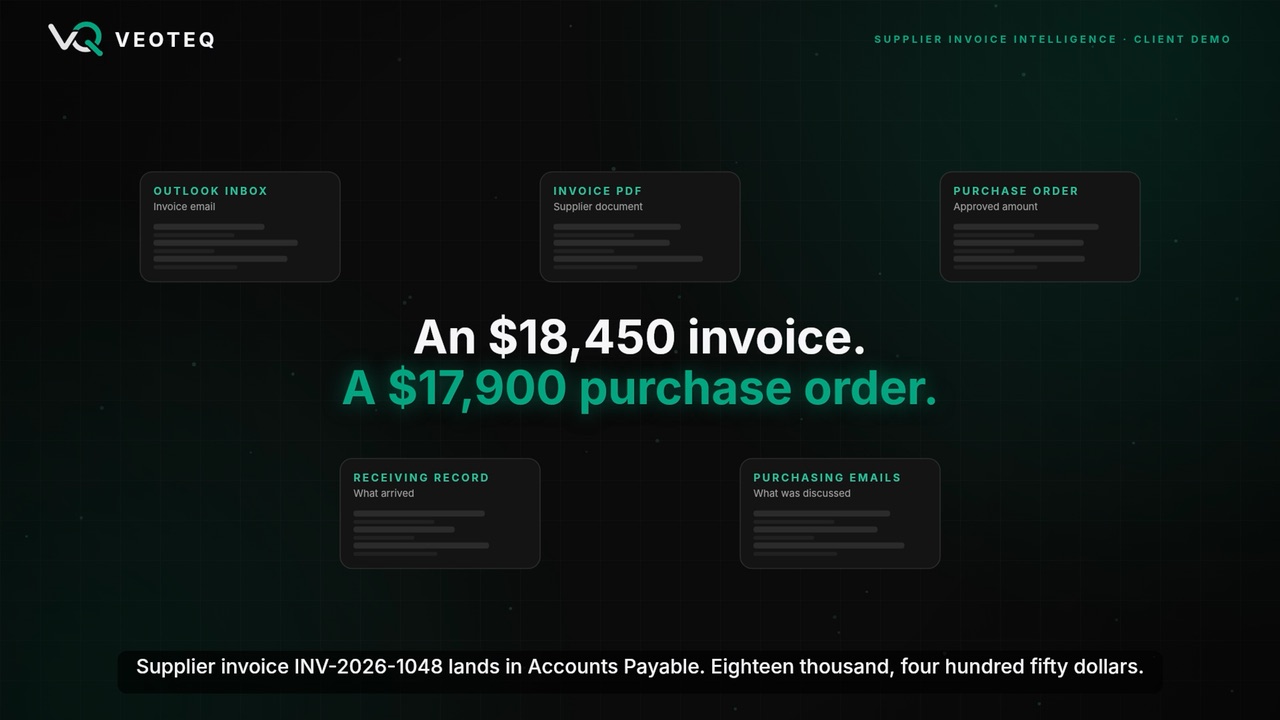
A three-way match tells Accounts Payable that an invoice is $550 over its purchase order. It does not say why. This article walks through the VEOTEQ Supplier Invoice Intelligence demo, which shows how AI investigates across email, the ERP and purchasing records, recommends an action, and leaves the decision to the right person.
Takeaways
- Matching finds the variance; the expensive part is the investigation and routing that follow
- AI can work across structured records, documents and correspondence to find the cause
- AI prepares the decision and a person owns it; payment controls stay unchanged
- Recording the cause of every exception turns repeat problems into process fixes
The gap that matching leaves
Modern ERPs, including NetSuite, already support three-way matching: they compare the purchase order, the receiving record and the supplier invoice, and flag a variance. That is necessary, and it is not new. What happens next is where finance time goes.
An Accounts Payable analyst opens the email, the invoice PDF, the purchase order, the receipt and the purchasing correspondence, then works out why the numbers differ and who must decide. In our illustrative model that takes 12 minutes per invoice, across 500 invoices a month. The expensive part is not the match. It is the investigation and the routing that follow it.
The scenario
The demo follows one synthetic invoice from a fictional supplier, Brightline Industrial Supply, to a fictional buyer, Halcyon Dynamics. Every figure is consistent across all scenes.
| Record | System | Amount | Note |
|---|---|---|---|
| Purchase order PO-7821 | NetSuite | $17,900.00 | Hex bolts $6,400, flange fittings $7,000, steel brackets $4,500 |
| Item receipt IR-5530 | NetSuite | $17,900.00 | 3 of 3 lines received, no freight recorded |
| Invoice INV-2026-1048 | Outlook (PDF) | $18,450.00 | Same three lines, plus $550.00 freight |
| Variance | Three-way match | +$550.00 | Freight is not on the approved PO |
Quantities and prices agree line by line. The whole difference is one extra line.
The flow, stage by stage
- Invoice arrives (Outlook). The AI reads the Accounts Payable inbox message and the attached PDF, and extracts supplier, invoice number, PO number and total.
- ERP records (NetSuite). It locates PO-7821, the item receipt and the vendor bill, and reads the three-way match result.
- Investigation. It compares line by line, then searches purchasing correspondence for context on any difference.
- Recommendation. It prepares an action with the supporting evidence attached. It does not pay and it does not reject.
- Decision (Microsoft Teams Approvals). The purchasing manager receives the request, reviews the linked evidence and approves, rejects or asks for more information.
- ERP update. On approval, the PO is amended to $18,450.00 and the vendor bill is approved. On rejection, a corrected invoice is requested from the supplier.
- Payment. The payable follows the company's normal approvals and payment run.
- Reporting (Power BI). Cycle time, effort and exceptions are measured and reviewed.
The investigation: where AI earns its place
This is the center of the demo. The AI works across three kinds of evidence that live in different systems:
- Structured records: PO lines, receipt lines and bill lines in the ERP.
- Unstructured documents: the invoice PDF and the email that carried it.
- Correspondence: purchasing emails from October that mention the supplier and the PO.
It first isolates the difference. Hex bolts, flange fittings and steel brackets match on quantity and price at $6,400, $7,000 and $4,500. The invoice adds one line, $550.00 freight, that appears neither on the PO nor on the receipt.
It then searches the correspondence. On October 14 purchasing noted that the supplier was asking about a freight surcharge for PO-7821. On October 16 the supplier wrote that $550 of freight would be added at invoicing. The AI looks for an approved PO amendment covering it and finds none.
The conclusion is precise: the charge was discussed, but it was never authorized. The recommendation is to request purchasing authorization for the $550.00 freight before finalizing the payable, with the invoice PDF, PO-7821, receipt IR-5530 and the emails linked as evidence.
Decisions and controls
The design principle is that AI prepares the decision and a person owns it.
- The right approver. The request goes to the purchasing manager, because the open question is a purchasing authorization, not an accounting one.
- Evidence in the request. The approval card carries the variance, the receiving status, the linked records and the recommendation, so the approver does not repeat the investigation.
- A recorded decision. The approval, the approver and the time are logged, and items the AI creates are labeled as such.
- Controls unchanged. After approval, the PO is amended and the bill approved in the ERP, and payment still follows the same approvals and the same payment run. The AI does not release funds.
- A defined rejection path. If the manager rejects the charge, the AI requests a corrected invoice from the supplier instead of posting the variance.
Measuring the outcome
The figures below are illustrative assumptions for a team processing 500 supplier invoices a month. They are not customer results.
| Measure | Before | With VEOTEQ AI | Basis |
|---|---|---|---|
| Handling time per invoice | 12 min | 3 min | Illustrative |
| Monthly effort | 100 h | 25 h | 500 × 12 min; 500 × 3 min |
| Hours recovered per month | 75 h | 100 h − 25 h | |
| Annual value | $40,500 | 75 h × $45/h × 12 months |
Exception-resolution time, approval turnaround, duplicate-payment prevention and invoice accuracy are natural additions where a company's own data supports them.
From exceptions to process fixes
One exception is a task. The same exception repeated is a process problem. Because the AI records the cause of every discrepancy, it can surface patterns. In the demo's illustrative 90-day view, freight not on the PO is the largest cause (14), ahead of price variance (9), quantity variance (6) and duplicate invoices (3).
That points to two concrete fixes:
- Purchasing: require a PO amendment before supplier freight is accepted, and add freight terms to the PO template.
- Finance: add a freight check to receiving review, and alert when invoice lines exceed the approved PO.
The benefit compounds: fewer exceptions reach Accounts Payable at all.
What the demo does and does not claim
- It uses synthetic data and simulated transactions. Nothing shown was posted or paid.
- It does not represent a live integration. A production deployment connects to a company's systems through their supported interfaces, under that company's security and access policies.
- It does not claim to have invented three-way matching. NetSuite already provides it. The value shown is the cross-system investigation and the routing of a decision.
- It is not a chatbot. People work in the tools they already use: Outlook, NetSuite, Teams and Power BI.
- Every KPI is illustrative and will differ by organization.
Your next step
Your company already has the systems, the information and the people. VEOTEQ helps you bring them together with AI to make better decisions, improve operations and achieve measurable business outcomes. Watch the 4-minute demo, or bring a recent invoice exception to a 30-minute AI Fit Call.